




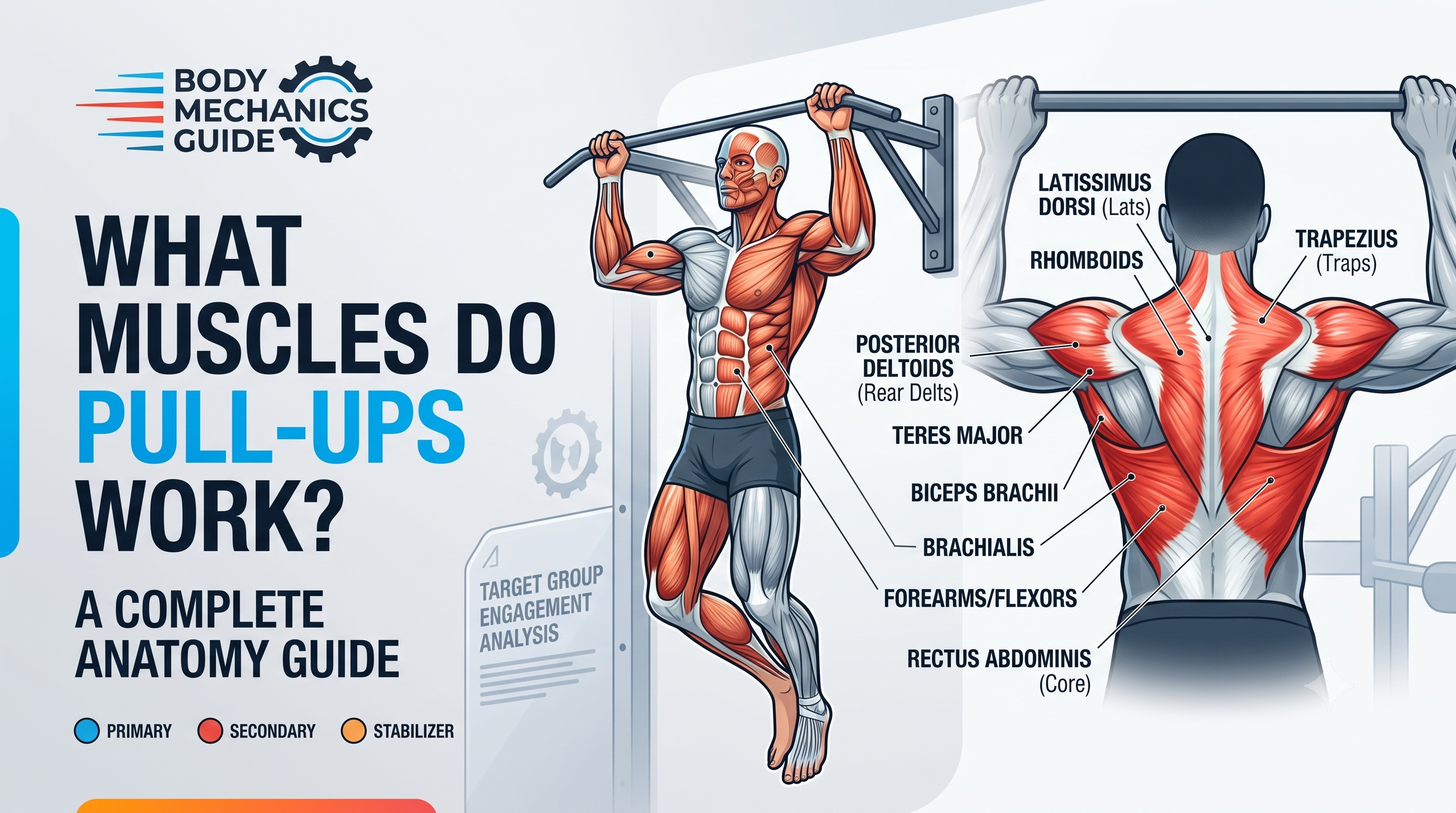
Pull-ups are a compound, multi-joint movement that engages multiple muscle groups simultaneously. They are a staple in any effective back workout because they build impressive upper body strength and size.
While the latissimus dorsi is the primary muscle worked, the pulling motion recruits a symphony of muscles that act as primary movers, synergists, and stabilizers.
Primary Muscles Worked During Pull-Ups (The Prime Movers)
These are the main muscles that drive the movement, responsible for pulling your body up to the bar.
Latissimus Dorsi (The Lats)
The "lats" are the large, fan-shaped muscles in your mid-to-lower back. They are the primary movers in a pull-up. Every time you pull yourself up, your lats are doing the heavy lifting to bring your arms down and back. Developing your lats is the secret to achieving that wide, V-shaped torso.
Rhomboids (Major and Minor)
Located between your shoulder blades, the rhomboids are essential for scapular retraction. They pull your shoulder blades together and down, which is critical for proper form and a strong, powerful pull.
Trapezius (Traps)
Your traps are the large, triangular muscles that run from your neck down to your mid-back. They help stabilize and move your shoulder blades throughout the entire movement.
Secondary Muscles Worked During Pull-Ups (The Synergists)
While your back does the primary work, several other muscle groups are heavily recruited to assist and stabilize the movement.
Biceps Brachii & Brachialis
These are the muscles on the front of your upper arm. They are powerful synergists, helping your lats pull your body up. You'll feel them working hard, especially as you get close to the top of the rep.
Posterior Deltoids (Rear Shoulders)
Located on the back of your shoulders, these muscles assist in shoulder extension and help stabilize your shoulder joint during the pull.
Forearms & Grip Muscles (Brachioradialis)
Your forearms and hands work isometrically to keep a tight grip on the bar. This is why pull-ups are one of the best exercises for building functional grip strength.
Teres Major & Minor
Often called the "little lats," these muscles assist the lats in shoulder adduction and extension.
Stabilizing Muscles: The Core & Beyond
A pull-up isn't just an upper-body exercise; it's a total-body movement.
Core (Abdominals & Obliques)
To prevent swinging and maintain a controlled, vertical line, your core must brace and stabilize your entire torso. This constant engagement means you're building a stronger, more resilient midsection with every rep.
Erector Spinae (Lower Back)
These muscles run along your spine and help keep your back straight and stable, preventing your lower back from arching excessively.
Pectoralis Major (Chest)
The chest muscles, particularly the lower and sternal heads, assist in the pulling motion, especially near the top of the movement.
How Grip Variations Change the Muscle Focus
The beauty of a pull-up bar is that you can change the angle of the exercise by simply adjusting your grip. A multiple grip pull-up bar like those from Slovic allows you to target your muscles from different angles.
| Grip Type | How to Do It | Primary Muscle Focus |
|---|---|---|
| Overhand (Pronated) | Palms facing away from you. | Maximizes lat and back engagement. |
| Underhand (Supinated) | Palms facing towards you (Chin-up). | Shifts more load to the biceps. |
| Neutral Grip | Palms facing each other. | A shoulder-friendly variation that equally engages the back and biceps. |
Pro Tip: A study found that pull-ups performed with a pronated grip and a 60cm grip width are optimal for maximizing latissimus dorsi activation.
The Slovic Advantage: Build Your Back at Home
Now that you know what muscles do pull-ups work, it's clear that this is a king of exercises for upper body development. It builds a wider, stronger back, powerful arms, a resilient core, and a vice-like grip.
With a Slovic pull-up bar, you can unlock these benefits right in your own home. Slovic offers a range of durable, high-quality bars to suit every space and need. Here are some of the best options to help you target all these muscle groups effectively:
For Standard Homes & Apartments
-
Doorway Pull-Up Bars: The best-seller for quick, no-drill setup in standard door frames.
-
Adjustable Pull-Up Bars: Perfect if your doorways have non-standard widths.
For Serious Strength Training
-
Wall-Mounted Pull-Up Bars: Heavy-duty permanent fixtures for daily, high-volume workouts.
-
Multiple Grip Pull-Up Bars: Features wide, narrow, and neutral grips to hit different angles of your back.
For Small Spaces & Portability
-
Portable & Foldable Pull-Up Bars: Ideal for students or professionals who travel frequently.
Get the Family Involved
-
Kids Pull-Up Bars: Start your children early with fun, strength-building habits.
Budget-Friendly Options
If cost is your primary concern, Slovic has high-quality steel bars available in every price bracket:
Frequently Asked Questions (FAQs)
Do pull-ups work the chest?
Yes, pull-ups engage the pectoralis major (chest) muscles, especially the lower and sternal portions, as synergists to assist in the pulling motion.
Are pull-ups better than lat pulldowns?
Pull-ups are superior for building functional strength, core stability, and grip power because they require you to lift your entire bodyweight. Lat pulldowns are more beginner-friendly and allow for precise weight adjustments. For best results, incorporate both into your routine.
How many pull-ups should I do to build muscle?
To build muscle (hypertrophy), aim for 3-5 sets of 8-12 reps. If you can't do that many yet, use resistance bands for assistance or focus on slow, controlled negative reps.
Can pull-ups give you a six-pack?
While not a direct ab exercise, pull-ups heavily engage your core to stabilize your body. Combined with a proper diet, they can contribute to a stronger, more defined midsection.
Conclusion
Pull-ups are a phenomenal exercise that works a wide array of muscles, from your lats and biceps to your core and forearms. They are a cornerstone of any effective strength training routine.
Stop wondering and start pulling. Your back will thank you. Explore the full range of pull-up bars at Slovic and find the perfect fit for your home gym today.